

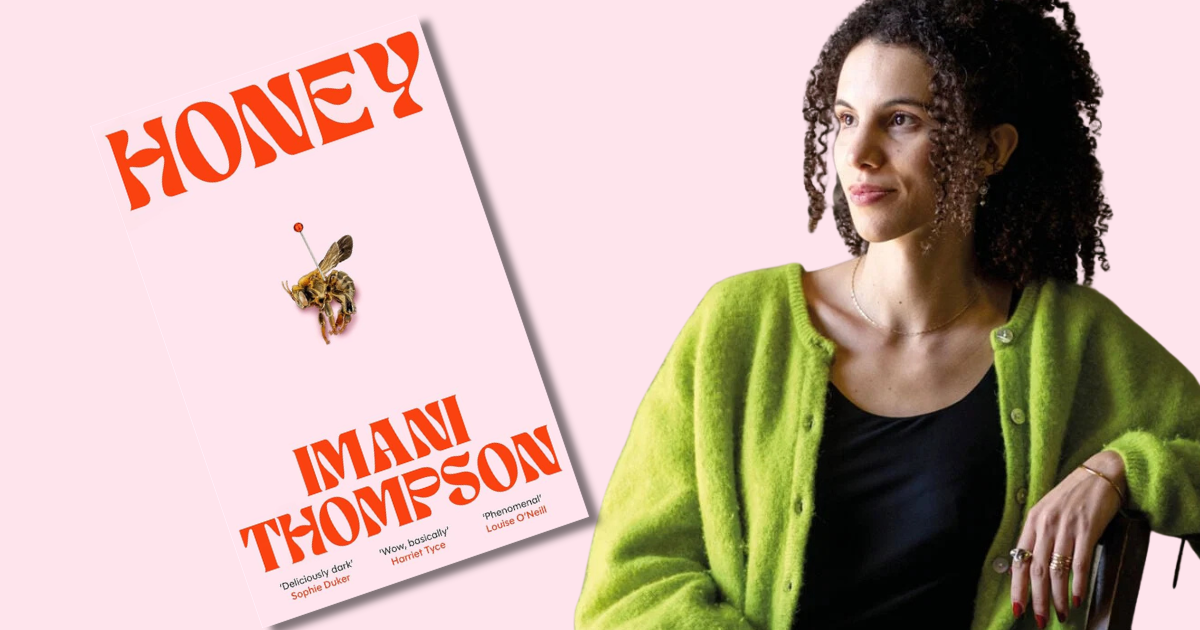
When Imani Thompson’s thriller, Honey, was released earlier this year, it took the literary world by storm. Telling the story of a murderous post-graduate student at Cambridge, the novel weaves intersecting themes of critical race theory and gender-based violence into a darkly entertaining crime thriller. We spoke with the Dorset-raised young writer about how growing up in the South West made her the writer she is and how she’s navigating the world of writing.
Imani will be joining us on Thursday 12 November at 7pm. Get your tickets here.
How do you think growing up in rural Dorset shaped you as a writer?
I definitely notice it most when I really need to concentrate and get a project finished, because I always have to come back to the countryside to write. Sometimes when I’m in London, there’s so much going on that I need the quiet of Dorset to really lock in and focus.
I think you have to make more of your own entertainment living in the countryside, so that’s probably fed into this very overactive imagination of mine. As a kid, sometimes you think you’d rather live in a city, but now I’m so glad I grew up in the countryside and have that appreciation for space. I’m really grateful for it.
You went to Thomas Hardye School in Dorset. Do you think growing up in a relatively rural community, particularly in terms of its cultural diversity, influenced the perspectives you explore in Honey?
I do, and I actually see it as a real positive. Before Dorset, I was living in Devon, again going to very small village schools. I definitely started to question things from a young age. My dad seemed to be the only Black guy around, and I was learning one history at school and being taught a different history at home.
It made me very questioning from a young age. My brother’s the same. It makes you observant, because if you’re slightly outside, or feel slightly outside, you have this eye for the things you’re not being told. That’s what led me to read the books I did, study what I studied and really wanted to interrogate racial politics, particularly in my first novel.
I don’t want it to seem as though we experienced a huge amount of racism in rural communities, because we didn’t. We’ve always had really happy times in the schools we’ve been in and met wonderful people. It’s more at a societal level that you start to think, “Something’s off.”
Did you spend much time back in Dorset while writing Honey? What did the writing process look like for you?
I started writing while I was working in London, taking any time I had after work or scraps of time here and there. Then I actually lost my job, which was quite helpful, even though it didn’t feel very helpful at the time. For two months, I thought, “I’m just going to burn through my savings and really try to invest in this manuscript and get it written.”
I spent some weeks at home during that time. When I was trying to get the first draft nailed down, I think I spent two weeks back home. My mum loves it when we come home to work. She’s always so nice to us: “Let me make you some food, just go up to your room and work hard.”
Every time I really have to get a book over the line, I tend to come home. There are no distractions. Where my mum lives, I’m surrounded by a few houses and sheep.
When it comes to the creative practice of writing, are you happily tapping away, or is it more like a ‘tortured creative’ process?
No way. When I think of a tortured creative, I think of people like Hemingway, drinking themselves into writing. I’m not like that. I think it’s an amazing job. I can’t believe this is my job, so I feel very lucky when I get to write.
That’s not to say it isn’t hard on the page. When you’re creating anything, there’s always the struggle of what to write next, whether it’s working and how you need to rearrange things. But those are nice problems to have.
You’ve spoken about using the crime thriller genre as a kind of ‘Trojan horse’ for the intersectional themes of critical race theory in Honey. Did you spend a lot of time considering the publishing industry when writing it?
For Honey, I was really considering the publishers, which is why I wrote a serial killer novel. I didn’t think that would be my first novel. I don’t read many books about serial killers, but I really wanted to write about race in a way that would be published, accessible and potentially commercial.
I was looking at everything being published in that space and knew it was tricky. I literally sat down and thought, ‘What sells? Murder.’ People seem to like reading books about murder.
Then I became excited because I thought, ‘What if I use this quite commercial genre to Trojan horse these themes into it?’ People might pick up the book because they like reading about serial killers, but they’re also picking up a book about critical race theory.
I wanted to see if I could interrogate the theory through the plot. That was exciting to me creatively: could I bring these two quite opposite worlds together, genre and academia? It was very much about looking at the publishing industry and thinking about what story might make it through and engage with these ideas in a slightly different way.
Has writing Honey given you more freedom with your next novel?
We hope so! I had this idea that if I’d done this with my first novel, then perhaps with the next one I could do what I liked. It’s not that I didn’t like writing Honey or that I was compromising on things; it just wasn’t what I expected my first story to be.
The draft of the novel I’ve just finished is probably more what I expected my novels to be like. It’s set in Dorset and looks at the climate crisis and migration. It’s a quieter novel than Honey, but I learnt so much writing Honey, particularly about plotting, and I think I’ll take that through all my writing.
The first draft took just over a year. This time, writing is my main job, which is a real luxury. I wasn’t worrying about being fired and having all those things going on.
What advice would you give to young people growing up in Dorset who want to pursue a creative career?
In a way, it depends on what your creative practice is. The beauty of writing is that you just need a laptop or a pen and paper. But whilst most opportunities are concentrated in big cities, there are opportunities in rural places, and sometimes they can be more accessible because there’s less competition.
I actually think it can be a real positive to have grown up rurally. Dorset Arts Council funding, or Bridport, is such a good example of amazing things happening locally. It’s worth finding all those local opportunities. It doesn’t have to be the traditional city path.
Sometimes, when you grow up in the countryside, especially as a kid, you think there’s nothing happening here. But when you look a bit more closely, you realise there is stuff going on and there are opportunities available to you. Celebrating where you’re from can be really helpful with your work.
Imani will be joining us on Thursday 12 November at 7pm. Get your tickets here.

Leave A Comment