

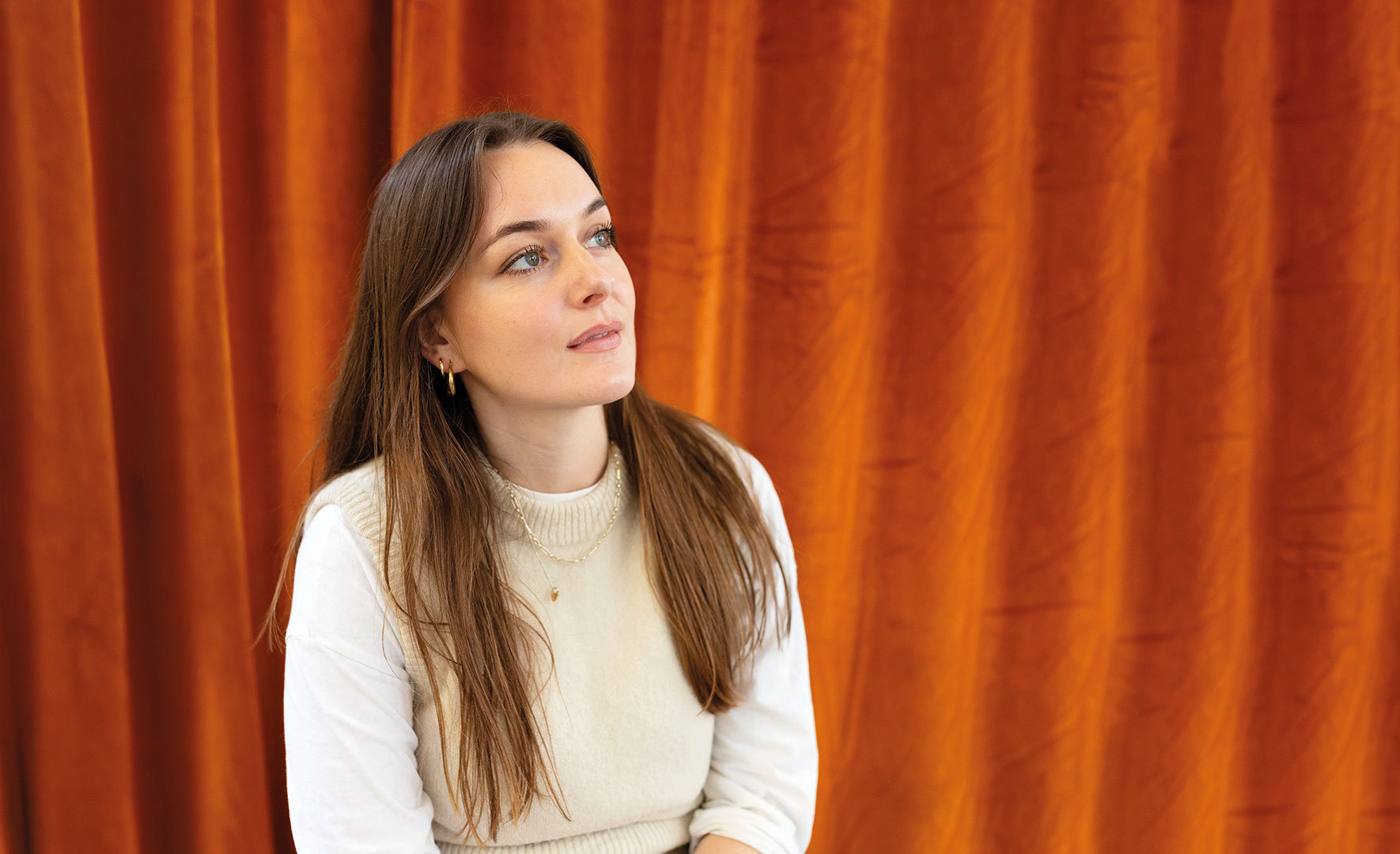
Cecilia Knapp is a poet, playwright, and novelist who will be sharing her experience and writing wisdom in three events across the BridLit programme. Her recent literary fiction novel, Lack, explores the modern zeitgeist through a thirty-something woman traversing grief, intimate relationships, and hedonism. The Young People’s Laureate for London 2020/2021, Knapp was also shortlisted for the 2022 Forward Prize for best single poem and was the winner of the 2021 Ruth Rendell Award.
On Sunday 8 November, she’ll join the young writers from writing collective Bank of Dreams and Nightmares as they share work produced during her writing workshops (tickets here). On Monday 9 November, the afternoon starts with an intimate writing workshop on poetry and prose (tickets here), before she joins Anna Whitwham for a talk on Lack (tickets here).
As we count down the last few days before BridLit begins, we sat down with Knapp to talk about her process, best writing advice, and the importance of workshops and events as a developing writer.
You’ve had an extensive career as a poet, but have also written regular columns, theatre pieces, documentaries, and now, two novels. Have you always needed variety and change in your creative career?
I think new modes bring new means of expression and new ways of thinking, and I suppose I’m drawn to that. There’s something a poem can do uniquely, something about distilling a very complicated feeling, whereas a novel can be a kind of expansive rumination on that feeling. And a play can say a lot in silences and in gestures as well as text. I suppose I wanted to have the opportunity to play with all of these things.
Can you walk me through how the ideas behind your latest novel, Lack, developed?
I knew I wanted to write about a daughter without a mother and to find a language to explore this loss. I also wanted to explore how a person’s past can shape their future, so I wanted some of the book to be a present-tense narration and some of the book to look back into the speaker’s childhood and deploy past-tense narration. Beyond that, I had no plan.
I started writing a sort of day in the life of the protagonist and found that all the anxieties of our current moment were coming out in the work— social media’s harmful impact, the omnipresent climate catastrophe, the rising cost of living. I was interested in how these anxieties affect a person and how they might intersect with their own existing vulnerabilities. In my protagonist’s case, living in the wake of profound grief and trauma.
As I continued writing, I became interested in how this context might understandably cause doubt around the possibilities of becoming a mother and also how a person grieving their mother might feel about having a child of their own. At various points, it felt right to dip into the speaker’s past and unravel the story of how she got to her present day. I let the writing lead me through her life, and that was how the novel unfolded.
Tell me a little about your writing process for this book.
I wrote it on a residency near Geneva in Switzerland in a beautiful chateau alongside other international writers. I was totally isolated from my normal life in peace, which allowed me to write a very messy first draft. Though the book is dark in places, I wanted the speaker to be funny and wry, and I challenged myself to write in a way I hadn’t before, less concerned with the impression I was making and more concerned with having fun and exciting myself in terms of risk and voice. Perhaps being so far away from home helped me do this too.
I was also reading Patricia Lockwood at the time and drew so much inspiration from the sheer life in her literary voice. The hard work came when I had to edit it down and find its shape and get rid of all the “working out” I did when writing to make room for the actual story and ideas. The residency was an immense privilege; usually I am squeezing writing in whenever I can: on my phone notes app, on buses, between teaching jobs. In lots of ways, this can be quite generative though; allowing yourself to just write without agonising over it can result in quite an elastic state.
Much of your career has been dedicated to teaching writing through workshops and projects like The Roundhouse Poetry Collective. What’s behind your dedication to facilitating creative writing?
It was a free writing workshop over 15 years ago that made me feel it was possible to be a writer. Before then, the concept was completely abstract. Time and space to write and to fail without judgement were crucial. Exposure to interesting poems, books and methodologies furnished me with skills and confidence and a sense of my own voice. So did community; a network of writers around me who I could show my work to and go to open mic nights with, where I would otherwise have been too scared to. It’s important for me that I play a small part in facilitating this for others and contribute to growing and sustaining our beautiful ecosystem of contemporary writing.
Through this experience, you’ve come in contact with countless potential writers. Is there a piece of advice that seems to be most useful for these budding creatives?
You don’t have to sound like anyone else but yourself. And don’t listen to snobs!


Leave A Comment