

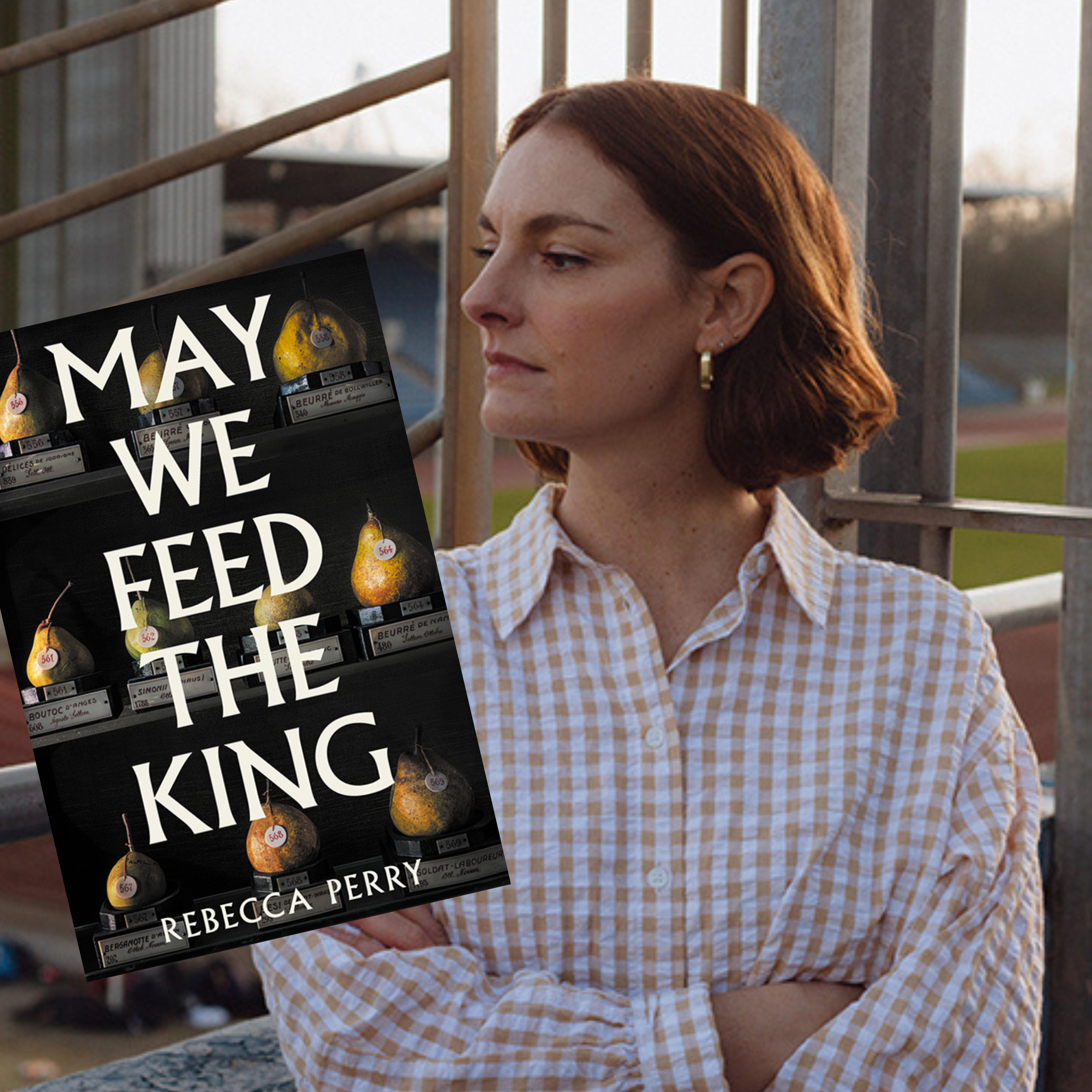
For those that enjoy spending their time in bookshops, Rebecca Perry will likely need no introduction. Her debut novel, ‘May We Feed the King’, has quickly become a favourite amongst booksellers and readers alike, stacked high in windows across the country. The Booker Prize-longlisted historical novel has been described as “ingenious” by The Guardian, and “vivid and rich” with “beautiful, breathing descriptions” by The Observer.
Perry has been publishing poetry for over a decade, much of which has been concerned with the past. The interest comes to a point in this novel, which explores the relationship between past and present, scholarly obsession, and how well we can really know history.
We sat down with Rebecca Perry to find all about whether AI will replace authors, what it takes to be a modern-day writer, and how to avoid laptop steam damage when writing a novel in the bath.
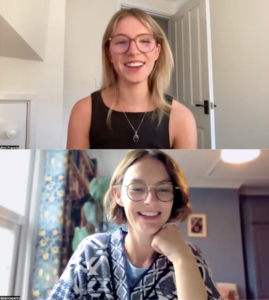
How do you find juggling your life as a writer with other work and modern life?
I juggle a lot of stuff outside my full-time job, and it’s getting harder to balance my two lives. I wrote my book around the edges. For a load of people, they don’t have that choice anymore. And I’ve always written poetry, which no one ever does full-time. So you get used to squeezing everything around the edges. I probably write better like that anyway.
How did you find the transition from writing poetry to a novel? It’s much more mammoth of a task.
I hadn’t written poetry for a few years by the time I started the novel. Because if I don’t have the compulsion to do it, then I just don’t, so I have accepted that the poetry has stopped for now. I didn’t sit and think I’m going to write a novel now, but I’d written a book about trampolining, a short-form, lyrical nonfiction sort of thing, which was really enjoyable and a nice halfway point between poetry and prose. So I started two short stories; one was about a woman who uses replica food in her home to conjure spirits to live alongside. And the other one was about the attendant to the king. I was tinkering around with them for ages, and then thought they might be the same story.
So, then I brought them together, but I didn’t sit down and intentionally start writing a novel. It was probably a year into playing around with a couple of short stories that it became a long-form piece of fiction. And then I actually found the writing process really similar to poetry. Not in lots of ways; it takes a lot longer, and the editorial process is very different. But it felt exactly the same in my body and brain to do the two.
I always knew I wouldn’t be able to write something very dense and chunky and linear. So I held onto what I find important in poetry while writing the prose, which made it easier. It felt like writing one really, really long poem. So it wasn’t painful, ultimately, which was a relief.
I really loved it, a lot more than I ever did poetry. But now I know what it takes to write a novel; I’m like, oh, I have to do that again! The unknown, the mystery, was really helpful the first time. I want to try and do another novel. But I won’t force it.
This book focuses on history and our relationship with the past. Did you find inspiration in British history and our culture?
With Maybe Feed the King, I chose not to set it anywhere specific. Most people reading think of England, but then I’ve had a couple of conversations with other people from Europe, and they see it in their country as well, which is what I wanted.
Having said that, I do think that as I was writing, I became more interested in questions around colonialism and empire. The things that drew me to writing about that world, that setup and court and hierarchies, were looking at how we have operated and continue to operate as a country, which is not good. We’ve done huge amounts of damage globally. So I was interested in looking at that and unpicking those mechanisms, things we take for granted about who leverages power.
In terms of British folklore, my friend Amy Key, who’s also a writer, and I had this amazing opportunity to go to Halsey Manor, which is the National Centre for Folk Art, for a residency. We got to go through all the archives, and that was so interesting because it’s so easy to feel completely disconnected from the world, the earth and also the people on it, and just accept that everything is automated and you don’t have to interact with people.
A lot of people are starting to realise that this isn’t a healthy way to live, and folklore is so grounded, particularly with marking the year in seasons rather than religious ceremonies, which I’m very, very for. I think it just feels a bit like there are ways to kind of reconnect more to the earth and the changing seasons than to the country, I suppose. I’m not a massive fan of this country, but I like the earth we live on.
As a storyteller, do you think you have an important part to play in reconnecting people to the past?
In the same way as a musician or artist. Everyone’s playing a part in connecting people to something less seeable or sayable. It’s quite important to be careful about the stories you choose to tell and how you tell them.
I completely made up my story, but then you have A. K. Blackmore’s new book, and it’s about the Peasants’ Revolt. I thought I knew about the Peasants’ Revolt, but I did not know about it at all. And it’s so energising to now know that hundreds of years ago, people decided they were not having it with the ruling classes, and did their best to do something about that.
And even if it didn’t end very well, there’s so much to be learned. It’s reassuring. People were really unhappy with how things were going a century ago as well. And people still are. There’s power in collective action. And a novel someone wrote can do that.
Do you have any specific routines or rituals to write?
I work at my desk for work, and it felt weird to be in the same space as I do my professional work. So, I wrote most of it in the bath, which was very helpful because I can’t get up and move around, like enforced containment. It’s lovely and peaceful, and it looks out over the garden, which helped as I wrote about flowers. My cat would always sit next to me.
It was helpful to have that space where half your body’s underwater; there’s a different perspective, like a lens or a pane of glass. Looking out into the garden, too, it felt like an interesting bodily experience to write there. I have a wooden tray for my laptop, which is still going strong after 12 years. I didn’t drop it, and I’ve avoided steam damage so far.
I also write lots while on transport. I can write on my phone, in a very haphazard way.
Right now, there’s a lot of noise about advancements in AI. As a writer, how does the situation sit with you?
I feel fear for the world, but not so much for creatives. Obviously, there have been issues around plagiarism and work being taken. I do find it chilling; I’m probably using AI all the time without realising it, but I’m not an AI user. I don’t worry it will take the jobs of writers, because I don’t think it will. I just worry about what it will do to society, the climate, and the world. So on a more human than writer level, I suppose.
It’s like how people have been saying for decades that people are going to stop buying books and that’s never happened. Books have not gone anywhere. I feel the same thing with AI. I think people care more about art and culture than they do about AI. Everything might just burn and be underwater before we have a chance to figure it out.



Leave A Comment